ZELJKO PANTELIC
01.11.2010 @ 12:11 CET
The final draft version of the Danube Strategy, prepared by the European Commission which, together with an associated Action plan, is to be finalised next week and unveiled on 8 December. The draft papers, seen by WAZ EUobserver, set highly ambitious goals: to ensure that, within 10 years, nobody in the Danube basin will need to leave their home region for the sake of higher education or employment or in search of growing prosperity elsewhere. The strategy also aims to double average income in the area by 2020.
01.11.2010 @ 12:11 CET
The final draft version of the Danube Strategy, prepared by the European Commission which, together with an associated Action plan, is to be finalised next week and unveiled on 8 December. The draft papers, seen by WAZ EUobserver, set highly ambitious goals: to ensure that, within 10 years, nobody in the Danube basin will need to leave their home region for the sake of higher education or employment or in search of growing prosperity elsewhere. The strategy also aims to double average income in the area by 2020.
"Within a decade the Strategy should have helped to make this a truly competitive region, and one of the most attractive in Europe for investors, with stronger transport links and a well-protected environment, secure and confident in the face of new challenges, including climate change and organized crime," the commission draft says.
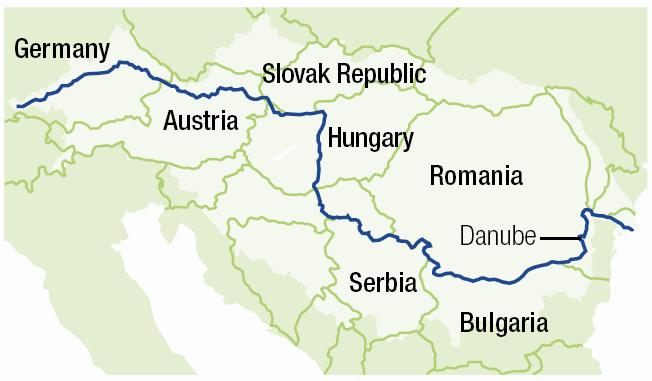
The Danube basin includes, primarily: Germany (especially Baden-Wurttemberg and Bavaria), Austria, the Slovak Republic, the Czech Republic, Hungary, Slovenia, Romania and Bulgaria inside the EU, as well as Croatia, Serbia, Bosnia and Herzegovina, Montenegro, the Republic of Moldova and parts of Ukraine.
The strategy sets out a series of problems and solutions.
Mobility: the Danube River itself is a major "TEN-T Corridor" - EU jargon for a priority zone for infrastructure investment. However, it is used way below its full capacity. Freight transported on the Danube is only 10 to 20 percent of that on the Rhine.
Energy: prices are high in the Region relative to world and European prices. Fragmented markets lead to higher transmission costs and reduced competition, raising prices.
Environment: this requires a regional approach to water management. Pollution does not respect national borders.
Risks: major, even catastrophic flooding and industrial pollution events are all too frequent.
Socio-economic: the region has very wide disparities. It has some of the most successful, but also some of the poorest regions in the EU. The share of highly educated people is lower compared to the EU27 average. The best often leave for opportunities elsewhere.
The Action plan concentrates on better transport connections and energy improvements; joint action on the environment and risk management; co-operation on security.
"We also can benefit from common work on innovation, tourism, information society, institutional capacity and marginalized communities. We must also move from words to action. The Strategy proposes an Action Plan, to which the countries and stakeholders need to commit themselves. We will regularly review progress. The Strategy is open-ended," the commission documents say.
Actions are organised into four "pillars:" transport connections; the environment; building prosperity; and improving security.
The maing targets are: by 2020, the Danube river should be navigable 300 days of the year; cargo transport (tonnage) should go up by 20 percent compared to 2010; railway connections should be established between all capitals by 2030;
Greenhouse gas emissions should fall by 20 percent compared to 1990; the share of renewables in energy consumption should go up 20 percent compared to 1990.
Tourists from outside the region should shoot up by 50 percent compared to 2010; cruise tourism on the Danube should climb by 50 percent; by 2020 80 percent of the Danube's waters should be suitable for swimming; the flood risk area should go down by 25 percent by 2020; internal trade should also leap up by 50 percent; the number of patents obtained in the region should rise by by 50 percent; 30 percent of people aged 30 to 34 years' old should have completed tertiary education; the average income of the population of the region as a whole should double. By 2020 it should not take more than four weeks to get permission for a business start-up.
There should also be an efficient system of exchange of information (including DNA) in the 14 countries by 2015; by 2015, there should be effective co-operation between all police forces of the 14 counties to help fight organized crime.
The new strategy will be implemented by aligning existing funding to its objectives, targeted on the region via numerous EU programs. There are to be no new EU funds, no new EU legislation and no new EU structures to support the initiative.
The Danube basin includes, primarily: Germany (especially Baden-Wurttemberg and Bavaria), Austria, the Slovak Republic, the Czech Republic, Hungary, Slovenia, Romania and Bulgaria inside the EU, as well as Croatia, Serbia, Bosnia and Herzegovina, Montenegro, the Republic of Moldova and parts of Ukraine.
The strategy sets out a series of problems and solutions.
Mobility: the Danube River itself is a major "TEN-T Corridor" - EU jargon for a priority zone for infrastructure investment. However, it is used way below its full capacity. Freight transported on the Danube is only 10 to 20 percent of that on the Rhine.
Energy: prices are high in the Region relative to world and European prices. Fragmented markets lead to higher transmission costs and reduced competition, raising prices.
Environment: this requires a regional approach to water management. Pollution does not respect national borders.
Risks: major, even catastrophic flooding and industrial pollution events are all too frequent.
Socio-economic: the region has very wide disparities. It has some of the most successful, but also some of the poorest regions in the EU. The share of highly educated people is lower compared to the EU27 average. The best often leave for opportunities elsewhere.
The Action plan concentrates on better transport connections and energy improvements; joint action on the environment and risk management; co-operation on security.
"We also can benefit from common work on innovation, tourism, information society, institutional capacity and marginalized communities. We must also move from words to action. The Strategy proposes an Action Plan, to which the countries and stakeholders need to commit themselves. We will regularly review progress. The Strategy is open-ended," the commission documents say.
Actions are organised into four "pillars:" transport connections; the environment; building prosperity; and improving security.
The maing targets are: by 2020, the Danube river should be navigable 300 days of the year; cargo transport (tonnage) should go up by 20 percent compared to 2010; railway connections should be established between all capitals by 2030;
Greenhouse gas emissions should fall by 20 percent compared to 1990; the share of renewables in energy consumption should go up 20 percent compared to 1990.
Tourists from outside the region should shoot up by 50 percent compared to 2010; cruise tourism on the Danube should climb by 50 percent; by 2020 80 percent of the Danube's waters should be suitable for swimming; the flood risk area should go down by 25 percent by 2020; internal trade should also leap up by 50 percent; the number of patents obtained in the region should rise by by 50 percent; 30 percent of people aged 30 to 34 years' old should have completed tertiary education; the average income of the population of the region as a whole should double. By 2020 it should not take more than four weeks to get permission for a business start-up.
There should also be an efficient system of exchange of information (including DNA) in the 14 countries by 2015; by 2015, there should be effective co-operation between all police forces of the 14 counties to help fight organized crime.
The new strategy will be implemented by aligning existing funding to its objectives, targeted on the region via numerous EU programs. There are to be no new EU funds, no new EU legislation and no new EU structures to support the initiative.
waz.euobserver.com

Δεν υπάρχουν σχόλια:
Δημοσίευση σχολίου