Εμφάνιση αναρτήσεων με ετικέτα crisis group. Εμφάνιση όλων των αναρτήσεων

Δευτέρα 12 Σεπτεμβρίου 2011

North Kosovo Meltdown

international crisis group
Marko Prelec, Crisis Group Balkans Project

6 Sep 2011
The long-simmering dispute over the Serb-held North of Kosovo has entered a dangerous phase. Serbia and Kosovo are raising tensions in the field despite making technical agreements at the negotiation table. On 2 September the EU brokered an agreement on customs stamps and cadastral records. Observers could conclude that the crisis started on 25 July at the border is now over. It is not. An important first step, the agreement says nothing about who will actually control the two disputed border posts and the customs revenue they generate. The real dispute is about the status of north Kosovo. Belgrade still believes it can partition Kosovo, keeping the Serb-inhabited north. Pristina is intent on asserting its practical sovereignty over its whole territory. Until the two work out a compromise the situation risks quick deterioration.....more...
read more: international crisis group
http://www.crisisgroup.org/en/publication-type/blogs/the-balkan-regatta/north-kosovo-meltdown.aspx

Macedonia: Ten Years after the Conflict

international crisis group
11 Aug 2011

EXECUTIVE SUMMARY AND RECOMMENDATIONS

Ten years after signature of the Ohrid Framework Agreement (OFA) that ended fighting between the country’s ethnic Albanians and Macedonians, much of the agreement has been implemented, and a resumption of armed conflict is unlikely. Macedonia is justified in celebrating its success in integrating minorities into political life, but inter-party and inter-ethnic tensions have been growing for five years. While this part of the Balkans looks to eventual EU membership to secure stability, it remains fragile, and worrying trends – rising ethnic Macedonian nationalism, state capture by the prime minister and his party, decline in media and judicial independence, increased segregation in schools and slow decentralisation – risk undermining the multi-ethnic civil state Macedonia can become. Prime Minister Nikola Gruevski, who has just formed a new government, should work closely with his Albanian coalition partners and opposition parties to pass and implement the measures needed for more democratisation, inter-ethnic reconciliation and a solution to the name dispute with Greece....more...
read more: international crisis group
http://www.crisisgroup.org/en/regions/europe/balkans/macedonia/212-macedonia-ten-years-after-the-conflict.aspx

Kosovo-Serbia: A Risky Moment for the International Community

international crisis group
Sabine Freizer

2 Aug 2011
For the first time since independence in 2008 there is a sense in Kosovo that the international community is choosing sides with NATO supporting the Kosovo government and the EU critical of it. The public perception may be false – as both NATO and EU are working closely together to assure security after the 25 July attempt by the Kosovo special police to take control of two custom posts with Serbia and the consequent burning of one of those posts by Serb protestors – but if this public perception persists tensions will rise, and it will become much more difficult for either party to mediate. One Kosovo police has already been killed....more...
read more: international crisis group
http://www.crisisgroup.org/en/publication-type/blogs/the-balkan-regatta/kosovo-serbia-a-risky-moment-for-the-international-community.aspx

Πέμπτη 9 Ιουνίου 2011

Ten Tasks for Turkey’s New Government

crisis group

Hugh Pope   |  9 Jun 2011

New cities, high-speed trains, suspension bridges, airports, tax holidays, a “crazy” grand canal parallel to the Bosporus waterway, iPads for all – the campaign trail ahead of Turkey’s 12 June parliamentary elections is strewn with promises of great times coming. Resolution of vexed questions in the domestic and foreign policy sphere has been relegated to the list of things “to be done after the election”. These more mundane challenges will however resurface as soon as the political class gets back to work.
So, based on Crisis Group’s four years of reporting in Turkey – and not counting the many challenges of the country’s booming economy, or what its external partners should also do – here are ten outstanding diplomatic and political tasks that we think should be tackled with determination by the new Turkish government....more....

read more: crisis group
http://www.crisisgroup.org/en/publication-type/blogs/eu-turkey-cyprus-triangle/ten-tasks-for-turkeys-new-government.aspx

Κυριακή 5 Ιουνίου 2011

What the arrest of Ratko Mladic means

inrenational crisis group

Sabine Freizer, CNN  |   26 May 2011


Sixteen years after the end of the war in Bosnia, the arrest of one of its biggest criminals is not only a great day for international justice and the conflict's victims, but the opportunity for the Balkans to finally move past its dark history.
Thousands of people were slaughtered at the hands of General Ratko Mladic, who is accused of genocide, crimes against humanity and violation of the laws of war in Bosnia-Herzegovina. That he was hiding all this time in Serbia was a constant reminder of injustice and impunity. Mladic was a huge barrier to reconciliation between Bosniaks, Serbs and Croats, even as an impotent fugitive. During the 1990s, a series of regional wars, often falling along ethnic lines, splintered Yugoslavia into today’s Balkan states. In what is now known as Bosnia, Serbian soldiers backed by Belgrade, sieged the city of Sarajevo and fought against both Bosnian Muslims and Croats. The war - which lasted from 1992 to 1995 - was marked by ethnic cleansing and mass atrocities, perhaps the most famous being the Srebrenica massacre, where Serbian forces led by Mladic killed 8,000 Muslim men and boys in just five days....more....

read more: interantional crisis group
http://www.crisisgroup.org/en/regions/europe/balkans/serbia/freizer-what-the-arrest-of-ratko-mladic-means.aspx

Δευτέρα 23 Μαΐου 2011

Bosnia: Crisis Averted - For Now

international crisis group
Marko Prelec

19 May 2011
Bosnia’s latest crisis has been averted – for now. The European Union secured the agreement of Bosnian Serb leader Milorad Dodik to cancel a referendum on the state judiciary and on laws imposed by past international High Representatives. In return, Brussels has promised to open a structured dialogue in Banja Luka which will eventually provide a comprehensive overview of the country’s judiciary. The High Representative (HR) did not have to act on his threat to annul the referendum decision, which would have increased tensions if the Republika Srpska (RS) had defied it. ...more....
read more: international crisis group
http://www.crisisgroup.org/en/publication-type/blogs/the-balkan-regatta/bosnia-crisis-averted-for-now.aspx

Κυριακή 22 Μαΐου 2011

The Dangers of Albania's Disputed Election

international crisis group
Sabine Freizer

20 May 2011
Albania’s second disputed election in three years threatens to push the country over the edge.
Almost two weeks after local elections, preliminary results have yet to be announced. This is the time for sustained, coordinated international action to press parties to abide by the legal framework in place. The Socialist Party should immediately appeal the decision of the Central Election Commission (CEC), to change counting procedures, to the highest appropriate legal mechanism (the Electoral College), which should decide the issue on the basis of current practice. All parties should exercise restraint if conflict is to be avoided; clarity is urgently required for the smooth running of future elections....more...
read more: international crisis group
http://www.crisisgroup.org/en/publication-type/blogs/the-balkan-regatta/the-dangers-of-albanias-disputed-election.aspx

Παρασκευή 13 Μαΐου 2011

Bosnia: State Institutions under Attack

international crisis group
Bosnia Briefing N°62 6 May 2011

OVERVIEW
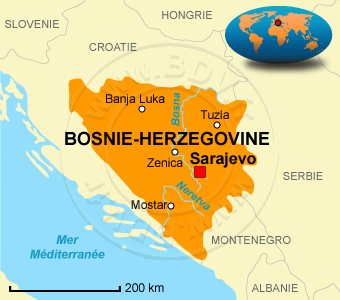
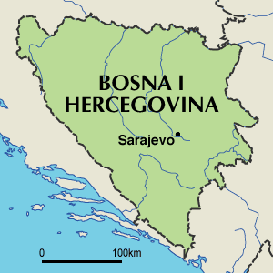
Bosnia faces its worst crisis since the war. State institutions are under attack by all sides; violence is probably not imminent but is a near prospect if this continues. Seven months after elections, there is no state government and little prospect for one soon. The authorities of the larger of the entities, the Federation, were formed controversially – a main state institution said illegally – in March and are disputed by Croats, who have created a parallel Croat National Assembly. The other entity, Republika Srpska, has called a referendum that could provide support for a Serb walkout of Bosnian institutions. With such trends, it is all too easy to imagine Bosniak parties overseeing a failed state whose institutions Serbs and Croats have abandoned. Compromises are needed so every Bosnian side can claim enough victory to justify retreat from the brink. The international community needs to step back from over-involvement in local politics to calibrate goals to a realistic appraisal of diminished powers and best guarantee stability. Then work needs to begin to create a context for renewing Dayton and achieving EU membership. ...more....
read more: international crisis group
http://www.crisisgroup.org/en/regions/europe/balkans/bosnia-herzegovina/b062-bosnia-state-institutions-under-attack.aspx

Δευτέρα 28 Μαρτίου 2011

North Kosovo: Dual Sovereignty in Practice


international crisis group

Europe Report N°211 14 Mar 2011

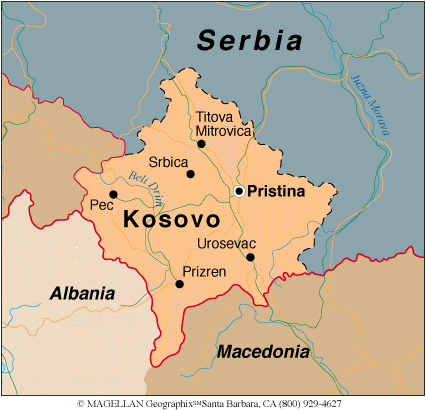
EXECUTIVE SUMMARY The dispute between Kosovo and Serbia is most acute in Kosovo’s northern municipalities. The North has not been under effective control from Pristina for two decades; its sparse and predominantly rural Serb population uniformly rejects integration into Kosovo. Though small and largely peaceful, it is the main obstacle to reconciliation and both countries’ European Union (EU) aspirations. A Kosovo-Serbia dialogue mediated by the EU began on 8-9 March 2011 and is likely over the coming months to look at some of the consequences of the dispute for regional cooperation, communications, freedom of movement and the rule of law. For now, however, Belgrade, Pristina and Brussels have decided that tackling the North’s governance or status is too difficult before more efforts are made to secure cooperation on improving the region’s socio-economic development, security and public order. ...more...

read more: international crisis group


Πέμπτη 13 Ιανουαρίου 2011

Bosnia: Europe’s Time to Act


crisis group

11 Jan 2011

OVERVIEW
After years of hesitancy, European Union (EU) member states should make 2011 the year when the lead international role in Bosnia and Herzegovina shifts from the Office of the High Representative (OHR) to a reinforced EU delegation. Bosnia has outgrown the OHR established in 1995 after the Dayton Peace Agreement and the creation of the Peace Implementation Council (PIC). Today the country needs EU technical assistance and political guidance to become a credible candidate for EU membership, not an international overseer to legislate for it or maintain security. Member states should rapidly install a comprehensive plan to reinforce the EU presence, including an embassy led by a strong ambassador, strengthen the membership perspective and build local credibility. OHR should withdraw from domestic politics and, unless a threat to peace emerges, focus on reviewing past decisions.
Member states should step up the EU’s presence even while Bosnia’s political parties struggle to form entity- and state-level governments more than three months after the 3 October 2010 general elections. Reform is urgently needed to avert political and economic crisis, but the OHR is no longer the entity that can cajole Bosniak, Serb and Croat leaders into change. EU membership perspective can better stimulate a shared vision of the country’s future among its leaders and encourage key reforms needed to improve institutional efficiency. “Enlargement fatigue” and the crisis of the euro should not allow sceptics among member states to undermine Europe’s success at securing stability in the western Balkans in what is a major test of the capability of the new European External Action Service (EEAS) to deliver a more effective common foreign and security policy.
The PIC announced its readiness to close OHR five years ago, but this now seems remote. Slipping calendar deadlines gave way in 2008 to a set of five objectives and two conditions (“five plus two”) – of which Bosnia has completed three of the former and one of the latter. Because the remaining two objectives – division of state property and of defence property – have defied all attempts at a political solution, OHR is likely to remain open throughout 2011, if not longer. Several non-EU PIC members also want to see stronger evidence of leadership from Brussels, notably through greater resource commitment, before handing over the baton.
Solution of the property issues has little bearing on state viability but has become a symbol of Bosnians’ ability to govern on their own. The symbol should not obscure the actual situation: Bosnians do manage their affairs without significant help. While the PIC and Bosnian elites have debated OHR’s fate, much of the transition to domestic responsibility has quietly happened. State institutions have full use of the property they need, despite lack of clear ownership status. The Serb-dominated Republika Srpska (RS) National Assembly passed its own property law in 2010, which is now being challenged at the Bosnian constitutional court. The armed forces have unhindered access to all military facilities and properties. Ownership will have to be established sooner or later, to allow for re-sale and investment, but this is not urgent.
The political scene has also shifted. Most Bosniaks voted for moderate parties in the 2010 elections while those who campaigned on the old issue of defence of the state against Serb challenges lost heavily. In RS, the ruling SNSD conducted a nationalist campaign but did less well than it had hoped. The small Croat population supported its own ethnic parties. Wrangling over the composition of the state government and its agenda has continued into 2011, when governments at state and entity levels – especially in RS – will face massive budget deficits, as the global economic slump belatedly hits Bosnia. Leaders consequently have limited room for intransigence. All major parties are now at least declaratively behind key reforms and speeding up EU integration; none count seriously on OHR intervention to help them with the required tough decisions.
Important PIC stakeholders such as the U.S., the UK and Turkey, together with some domestic elites, worry that Bosnian politicians are not ready to govern on their own (though sovereign Bosnia has been entrusted with a UN Security Council seat) and will be unable to form a functional coalition government, that the RS will attempt secession and violence ensue. They fear OHR closure would trigger the country’s break-up, or at least remove a barrier to moves in that direction. But the OHR is no longer the security guarantor it once was. In the event of a threat to territorial integrity and advised by their on-the-ground ambassadors, the EU, the U.S. and others in the international community could muster the political will and military means to act, whether OHR remains or not; Bosnian politicians who acted irresponsibly would be vulnerable to the same diplomatic and other international mechanisms, including sanctions or, in the extreme case, use of force, as any other national leaders. Meanwhile, however, the OHR gives them an excuse to deflect responsibility for their failures to the international community.
2011 can be the pivotal year during which the EU builds up and the OHR downsizes gradually. For an effective soft transition, EU member states and the key Brussels players – primarily the EU High Representative for Foreign Affairs and Security Policy/Vice-President of the European Commission (Catherine Ashton) and the European Commission – should take several steps in parallel:
Ashton should name, without extending what is already a six-month delay, a strong ambassador to head the EU Delegation (the formal term for its embassy) in Sarajevo, ideally a former member-state senior official with solid EU experience in, particularly, enlargement issues;
increase significantly the capacities of the Delegation’s political section to advise the ambassador on Bosnian developments, liaise with senior party and government leaders on bringing legal and institutional structures into compliance with EU norms and coordinate the contributions of other EU actors;
create or strengthen the Delegation’s legal, communication, economic and security sections, drawing on other EU staff already in Bosnia and upgrading the field office in Banja Luka; increase the Delegation’s own budget to a level commensurate with its new responsibilities; and
increase funding under the Instrument for Pre-accession Assistance (IPA) to levels comparable to those in neigh­bouring countries and consistent with the EU’s stated aim to lead in Bosnia.
Though the EU has long aspired to lead the international effort in Bosnia, member states and other Brussels actors still have to settle differences over timing, strategy, staffing and financing of a reinforced presence and mission. If they cannot do so in early 2011 – starting with a comprehensive discussion by foreign ministers at the 31 January Foreign Affairs Council – and Bosnian officials fail to support the process by making a genuine effort to work towards EU integration, the handover risks being botched. Bosnia could then be left with the worst of both worlds: rivalry between an enfeebled OHR and an EU Delegation struggling ineffectively to assert itself.
To help avoid this, the PIC should:
refocus OHR on its own unfinished business, especially dealing with the cases of Bosnians it has barred from public office, while limiting its use of executive powers to a true emergency;
support the EU’s leading role in Bosnia by agreeing to a transfer of the EU Special Representative (EUSR), currently double-hatted as the High Representative, and that official’s staff to the EU Delegation; and
continue to commit to Bosnia’s territorial integrity and sovereignty, support the executive mandate of the EU military force (EUFOR) that took over from NATO in the country and keep the UN Security Council apprised of any threat to the 1995 Dayton Agreement or subsequent Security Council resolutions.
Once freed from its link to OHR, the EU’s diplomatic team should be able to focus on facilitating the political process and helping Bosnia’s disparate communities find the single voice required to interact responsibly with their European neighbours.
Sarajevo/Istanbul/Brussels, 11 January 2011

read more: crisis group