Εμφάνιση αναρτήσεων με ετικέτα Ari Rusila. Εμφάνιση όλων των αναρτήσεων

Πέμπτη 17 Νοεμβρίου 2011

Media War of Yugoslav Secession continues

ari rusila's balkan blog
November 6, 2011

”Who needs facts if a good story is available?” (Ari Rusila)

A few weeks ago I promoted new Srebrenica documentary film Srebrenica: A Town Betrayed . Everybody was not happy about critical view of documentary. E.g the Norwegian Helsinki Committee made official complaint to Norwegian Broadcasting Council and Press Complaints Commission. This is not surprising as media war in Bosnia started same time as war on the ground. While the whole artificial outside forced state creature without any own identity is now openly tottering the media again is the tool to improve political interests....more...
read more: ari rusila
http://arirusila.wordpress.com/2011/11/06/media-war-of-yugoslav-secession-continues/

“Srebrenica: A Town Betrayed” – Finally a Critical Documentary about Srebrenica Tragedy

ari rusila's balkans blog
“If you want to use a word “genocide” (for Srebrenica) – then OK, but we need a new word to replace the old “genocide” word…” (Noam Chomsky)

Srebrenica: A Town Betrayed a Norwegian documentary film directed by Ola Flyum and David Hebditch is now free to watch in Youtube. The film approaches Srebrenica tragedy from a bit different viewpoint than usual in Western mainstream media. Norwegian documentary about Srebrenica challenges generally accepted narratives about the 1995 massacre giving light to the civil war in Bosnia and Herzegovina from non-biased point of view. It also connects Srebrenica into a wider context that is often ignored by the Western media, showing the crimes committed by the Bosnian army against Serbian civilians and villages in the area. These atrocities may also partly explain why some war crimes happened later in Srebrenica.....more...
read more: ari rusila
http://arirusila.wordpress.com/2011/09/25/srebrenica-a-town-betrayed-%E2%80%93-finally-a-critical-documentary-about-srebrenica-tragedy/

Κυριακή 5 Ιουνίου 2011

Mladic in Hague, Serbia towards EU, reopening Srebrenica

ari rusila's balkan blog
From historical perspective the Mladic’n arrest and the Hague trial serves as formation of a more comprehensive picture of events in the Balkans in the 90′s after the procecutor and the defense have made their case. Issues related to the underlying policy objectives of Srebrenica, events before Srebrenica and the number and the PR game around Srebrenica. Realization of the right however is only theatrical minor point for the EU and for the current Serbian government as both see it only as a formal step towards Serbia’s EU membership....more....
read more: ari rusila's balkan blog
http://arirusila.wordpress.com/2011/06/02/mladic-in-hague-serbia-towards-eu-reopening-srebrenica/

Πέμπτη 28 Απριλίου 2011

Serbia’s EU association is not a Must

ari rusila's balkan blog
April 25, 2011

“If the Balkans find that too many obstacles are strewn about the road to Brussels, they may well be tempted to set out on the shorter road to Istanbul”
(Misha Glenny, Balkan political analyst)
Practically the Eastern EU enlargement for the moment is stopped. Croatia’s membership is a bit delayed, Turkey’s EU bid is dead as continent simply has no intention of ever incorporating 70 million Muslims and the rest – such as Serbia – are still more or less in association process. Tens of thousands demonstrators demanded early elections in Serbia at a protest rally 16th April 2011, blaming Serbia’s pro-Western government for a deepening economic crisis and alleged corruption. The government has rejected the demand for early elections, saying they will be held after Serbia wins candidacy for EU membership in the autumn. European Commission (EC) unanimously agrees that early parliamentary elections in Serbia should not be called which position in my opinion gives a strange picture about EU’s view towards democracy – really a view that democratic elections would harm stability and EU-accession. ...more...
read more: ari rusila's balkan blog
http://arirusila.wordpress.com/2011/04/25/serbias-eu-association-is-not-a-must/

Δευτέρα 28 Φεβρουαρίου 2011

The Art of Witness and Peace in Bosnia


ari rusila

In the close to 20 years since the beginning of the Bosnian War, much has happened. Thousands have been massacred, international forces have intervened, peace agreements have been negotiated, individuals have been tried for war crimes, refugees have fled. Yet, in the midst of this difficult story, it is inspiring to know that people have resisted against the brokenness and destruction that consumed the conflict. Here are two examples of how human spirit and creativity have used art to remember and reconcile the war from its very first year until today.
Witnesses to Evidence
The seige of Sarajevo began in April 1992. Six months later, in the shelled and rundown Sujetska Cinema, a gallery director and eight artists gathered to create something as a witness to the conflict. From that October to April 1993, the artists collaborated on a series of works inside the hidden hallways of the cinema, where Sarajevans frequently passed through to escape snipers outside. The gallery director, Mirsad Purivatra, and the eight artists – Nusret Paši, Zoran Bogdanovi, Ante Juri, Petar Waldegg, Mustafa Skopljak, Edin Numankadi, Sanjin Juki, and Radoslav Tadi- created a living testimony to the war they themselves were living.
The exhibit was themed around and subsequently named Witnesses to Evidence, after Nusret Paši’s piece. The exhibit was invited to represent Bosniz-Herzegovina at the 45th Venice Biennale, but because of the wartime blockade, the artists and their works were unable to travel. However, later in the spring of 1994, they could finally leave. Witnesses was brought to exhibit at the Kunsthalle in New York, and the schedule was ideal. At the time, international audiences were gathering in New York to discuss the aftermath of the Bosnian conflict. More attention was being given to the consequences of the war.
What many found compelling about Witnesses was not so much its representation of the war, but more so the sense of obligation it passed on to its viewers to act as witnesses to history. After he saw the exhibit in New York, Johannes H. Biringer, an artistic director and the author of Performance on the Edge: Transformations of Culture, wrote a commentary about what the artists had done:
“They build meaningful compositions of the human spirit and intelligence in midst of the war’s insanity,” Birringer stated, “Thus they become also witnesses of our indifference; their irony and resiliency shame us. Their work also proves that it is neither impossible nor frivolous to make art in the time of war; perhaps making art in such a time is as necessary as finding food and shelter and healing the wounded.”
Most Mira
A little over a decade after Witnesses exhibited in New York, Bosnian-born Kemal Pervani and social researcher Lea Esterhuizen founded Most Mira, a charity organization based in Britain and Bosnia. Most Mira means ‘Bridge of Peace’ and fittingly, the organization’s mission is to build understanding and tolerance among youth in Northwest Bosnia by means of creative community arts.
Imagine this: 500 Bosnian, Serb, Croat, and Roma kids frolicking around for a week dancing, playing games, playing music, painting, writing, and singing. It’s a picture in stark contrast to war. That picture is of the Youth Festival that Most Mira has organized since 2009. And now, the charity’s energetic and innovative Trustees and Action Team are in preparation to launch this year’s festival scheduled for May 16-20, five days of workshops in art, drama, circus skills, dance, music, media, and performance. With May approaching, they’re in the last leg of the hunt to recruit volunteers, the ones who really make the festivals possible. Though, the point of it all reaches far beyond the fun and games. In a fragmented society shadowed by the war’s aftermath, what Most Mira and these volunteers do is help continue the work of remembrance and reconciliation that began in Sarajevo all those years ago.

read more: ari rusila

Πέμπτη 13 Ιανουαρίου 2011

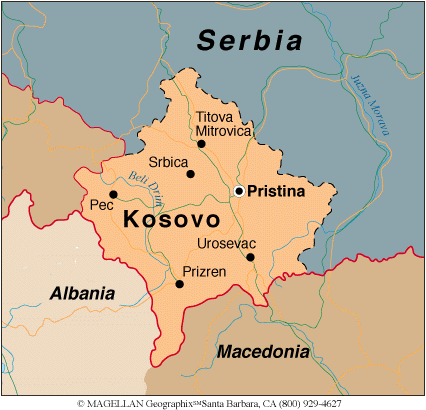
Captured Pseudo-State Kosovo

ari rusila's balkan blog
January 12, 2011
“We Bombed The Wrong Side” (General Lewis Mackenzie)
In my previous articles I have portrayed Kosovo with quite dark colours. I have summarized Kosovo
“as Serbian province, occupied and now international protectorate administrated by UN Kosovo mission; as quasi-independent pseudo-state has good change to become next “failed” or “captured” state; today’s Kosovo is already safe-heaven for war criminals, drug traffickers, international money laundry and radical Wahhabists – unfortunately all are also allies of western powers”.

This description can naturally be seen as individual biased view without any connection to reality. However the process which began before Xmas may lead similar outcome in western mainstream media too. Investigations conducted by the Swiss diplomat, Dick Marty on behalf of the Parliamentary Assembly of the Council of Europe (PACE) have revealed the true picture of Kosovo’s prime minister Hashim Thaci. In his report to the PACE’s Commission, Thaci is presented as the leader of a criminal gang engaged in the smuggling of weapons, the distribution of illegal drugs throughout Europe and the selling of human organs for unlawful transplantation. The Swiss senator conducted a two-year inquiry into organised crime in Kosovo after the Council of Europe mandated him to investigate claims of organ harvesting by the Kosovo Liberation Army (KLA) after the war with Serbia ended in 1999.
Western intelligence agencies warned that Hashim Thaci ran an organised crime network in the late 1990s, they knew the KLA were criminals running the drug, slave, and weapons rackets throughout Europe, they knew the KLA was supported by Osama bin Laden (with whom Thaci met personally in Tirana in 1998 to plan the jihad in Kosovo. Despite this Western political leaders backed his Kosovo Liberation Army and its members were transformed as “freedom fighters”.
The case related to organ trafficking is now in Pristina court, according Swiss sources PM Thaçi has been prohibited from entering Switzerland “for a certain period of time”, investigations are called for allegations that sums originating from organ trafficking in Kosovo and Albania had been deposited in Swiss bank accounts. Swiss Foreign Minister Micheline Calmy-Rey has reportedly decided not to receive an award given by the Kosovo Embassy and members of the Kosovo diaspora, for her contribution to the recognition of Kosovo’s independence. The award ceremony was planned to be held on 21. December, 2010 for her contribution to the recognition of Kosovo’s independence. (Source: Euractiv ).
Organ trafficking case
In April 2008 Madam Carla Del Ponte, the former Chief Prosecutor of the International Criminal Tribunal for the former Yugoslavia (ICTY), published a book “La caccia – Io e i criminali di guerra”. In the book, almost ten years after the end of the war in Kosovo, there appeared revelations of trafficking in human organs taken from Serb prisoners, reportedly carried out by leading commanders of the Kosovo Liberation Army (KLA). Now the report, “Inhuman treatment of people and illicit trafficking in human organs in Kosovo” , for Council of Europe Parliamentary Assembly (PACE), prepared by Swiss prosecutor-turned-politician Dick Marty, expands on allegations made by Mrs. Del Ponte.
The PACE report claims that civilians – Serbian and non-KLA-supporting Kosovan Albanians detained by the KLA in the 1999 hostilities – were shot in northern Albania and their kidneys extracted and sold on the black market. It names Hashim Thaçi, the former leader of the KLA and Kosovo’s prime minister, as the boss of a “mafia-like” group engaged in criminal activity – including heroin trading – since before the 1999 war.
A Council of Europe report into organ trafficking in Kosovo linked the Medicus case to a wider criminal network in the Kosovo Liberation Army (KLA), which began trading in organs in 1999. A faction within the rebel guerilla army loyal to Thaci has been accused of overseeing a racket involving Serb captives. A “handful” were said, in the report, to have been shot in the head, then had their kidneys extracted. It is believed the kidneys were flown to Istanbul in ischemia bags. Thaci has strongly denied the claims. I also touched on a matter in my article New Cannibalism in Europe too? a couple of years ago.
In November 2008 police raided the property of Medicus clinic in a deprived suburb near the Kosovan capital Pristina. Patients from Canada, Germany, Poland and Israel had received organ transplants at the clinic. Victims were promised up to $20,000, while recipients were required to pay between €80,000 and €100,000 euros. But despite promises of payment the donors had left empty-handed; up to 30 victims lost their kidneys in the clinic in just eight months in 2008. The key player of is Dr. Yusuf Ercin Sonmez from Medicus clinic has been a key player in the unscrupulous organ market for more than 10 years.
A Washington-based intelligence source said the kidneys were sold to Dr. Sonmez, a 53-year-old medic. It was then that the Turkish doctor was said to have struck up a relationship with Kosovan Albanians, who, investigators believe, are implicated in the Medicus clinic case which unfolded in the confirmation hearing case on December in Pristina district court. (Source: The Guardian: The doctor at the heart of Kosovo’s organ scandal )
However the present case is limited to Medicus clinic and its links to a wider network of Albanian organised criminals and events a decade ago will hopefully take place in wider trial. EU’s EULEX-operation in Kosovo will from its side examine allegations that the country’s prime minister is the head of a “mafia-like” criminal network linked to organ trafficking. if there is sufficient evidence against Thaçi or the other senior government figures implicated in the report, they could face prosecution even though most crimes are alleged to have taken place in Albanian territory. (Source e.g: The Guardian: The doctor at the heart of Kosovo’s organ scandal )..more...
http://arirusila.wordpress.com/2011/01/12/captured-pseudo-state-kosovo/
ari rusila's blog
http://arirusila.wordpress.com/2011/01/12/captured-pseudo-state-kosovo/

Πέμπτη 30 Δεκεμβρίου 2010

War Crime Hypocrisy


Ari Rusila's balkan blog


December 29, 2010


Related to Serbia’s EU association process nearly every progress report of European Commission highlights Serbia’s cooperation with Criminal Tribunal for the former Yugoslavia (ICTY). Although the country has demonstrated its commitment to moving closer to the EU by building up a track record in implementing the provisions of the Interim Agreement with the EU and by undertaking key reforms the fact that so far as indictees Ratko Mladić and Goran Hadžić are still at large it is hard to demonstrate full cooperation with ICTY. As ICTY cooperation is a key priority of the European Partnership this makes a formal cause to halt association process (and if fugitives will be deported to Hague then the next obstacle will be recognition of Kosovo).


While EU speaks about standards or criteria during association talks so should some already members look occasionally mirror. Few news about older war crimes from last months popped to my eyes and raise a doubt in my mind about double-standards. Suspected hypocrisy does not limit to EU only but to U.S. and Nato as well. EU seems be unwilling to put their war crimes from recent history on the same line than other smaller players ones. ...more...


read more:Ari Rusila's balkan blog


http://arirusila.wordpress.com/2010/12/29/war-crime-hypocrisy/

Τετάρτη 17 Νοεμβρίου 2010

Will Negotiation Slot for Kosovo be used?


ari rusila's balkan blog

When UN made new Kosovo related decision on September 2010 it was believed that resolution would enable a dialogue for resolving this frozen conflict. With minimal preconditions new direct talks between Belgrad and Pristina and a possible deal between local stakeholders could open the way for sustainable solution. However resent events have have resulted in stalemate: President of separatist Kosovo government resigned and dissolution of the government itself have put the focus in Kosovo on next elections which will be held in December 2010. Meanwhile also Serbia starts soon preparations for its next next elections, due by spring 2012.

Thus there is a narrow negotiation slot between the time when a new Kosovo government takes office and to end successfully before the Serbian election campaign makes any compromise impossible. The core question is if there is political will to start talks with the aim of reaching as comprehensive a compromise settlement as possible.
Serbs and Albanians have been in negotiations and talks half a dozen times over the past two decades – from the tentative efforts of the 1990s to the doomed talks in Rambouillet, France, in 1999 and the later “status” talks between 2005 (Ahtisaari’s pseudo-talks) and 2007 (“Troika” led talks). None of these has led to tangible results and left outsiders imposing an outcome, be it NATO intervention or proposing the Ahtisaari plan.

The original or better to say official aim of international community was to build “standards before status”, on 2005 the task was seen impossible so the slogan changed to “standards and status”. Even this was unrealistic so Feb. 2008 “European”standards were thrown away to garbage and “status without standards” precipitately accepted by western powers. For international community I don’t see any success story with this backward progress. Thus the multi-ethnic idea is far away despite EU’s billions. The remaining Serbs in Kosovo are barricaded into enclaves keeping their lives mainly with help of international KFOR troops or in de facto separated Serb majority region in North Kosovo. This has changed former multi-ethnic province more mono-ethnic one.

more

...........

Δευτέρα 11 Οκτωβρίου 2010

Rethinking needed after Bosnian elections


October 10, 2010

In my earlier article – Bosnia on the road to the EU, sorry to Dissolution – I described a bit the background and made some small forecast about outcome which seems to be not so far away from reality. Now elections are held and most votes counted. Turnout in the vote — the sixth general elections in Bosnia since the end of the 1992-95 war – was some 56 percent, the highest since 2002 (in 2006 the turnout was 55.3 percent).The Organization for Security and Co-operation in Europe (OSCE) has assessed that the elections were generally in line with international standards for democratic elections, although certain areas, including ethnicity and residence-based limitations to active and passive suffrage rights, require further action.


Bosnia is created according Dayton agreement and split into two semi-independent entities – the Serb dominated Republika Srpska (RS) and Bosniak-Croat populated The Federation of Bosnia and Herzegovina (FBiH) federation which together form the basis of Bosnia and Herzegovina (BiH).


Σάββατο 9 Οκτωβρίου 2010

Bosnia on the road to the EU, sorry to Dissolution


October 2, 2010
”Young people, they are starting to think that ethnic divisions are normal … if something doesn’t happen to change this, there will be no change.” (Emin Mahmutovic, civic activist).


Despite international community’s state building efforts in Bosnia the country is splitting parts Since war 15 years ago foreign aid has exceed USD 80 bn for artificial creature designed in Dayton agreement aiming multi-ethnic state with EU perspective. As a result Bosnia is now even more divided, with less national identity, 20 percent of population living under the poverty line, with a nightmare triple administration plus international supervising making the country as worst place in Europe to do business west of Ukraine, even as it seeks to join the European Union. (Bosnia this year ranked 116th in World Bank’s ease of doing business index.)


Ari Rusila's blog