February 24, 2011
By Vlad Popovici*
The European Union Commission has adopted in early December the EU Strategy for the Danube Region. This new regional strategy focuses, among other things, on energy aspects, and is more than relevant for South-East Europe, as six of the fourteen countries covered by the new macro-strategy are in this region.
………………………..
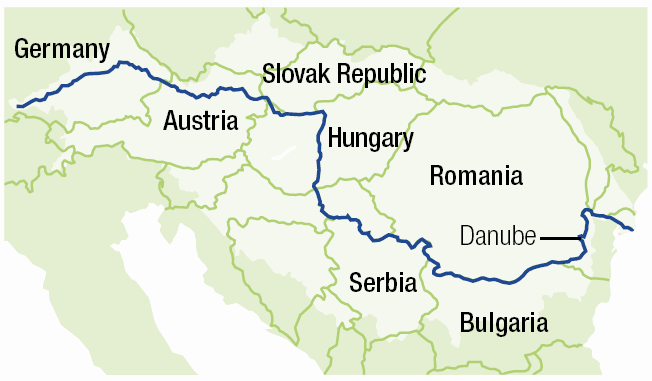
The Danube River was for centuries one of the most important trade routes connecting Central Europe to SE Europe, and Europe in general to other regions, such as the Caspian region or the Near and Middle East. It provided cheap transportation and an avenue for not only economic, but also cultural, religious and political exchanges.
During the 20th century, however, the Danube lost its interregional corridor status, becoming more of a closed, impenetrable border, sometimes between countries, and sometimes between the opposed ideological camps of the Cold War. River transportation significantly declined and cooperation initiatives focused on the Danube – in business, culture, tourism, the environment and so on – virtually stopped.
EU Strategy for the Danube Region
The European Union launched in 2009 its first macro-regional strategy targeted at the
Baltic Sea Region. The strategy’s main objective is to create a long-term development and cooperation framework for the region. Encouraged by the positive reaction of the region’s governments, businesses and general public and by the strategy’s early implementation success, the EU wants to use a similar policy approach for the Danube region.
In June 2009, the European Council asked the EU Commission to prepare a
strategy for the Danube region. The Danube region includes, from the EU’s perspective, the entire river’s basin: Germany (Baden-Württemberg and Bavaria), Austria, the Slovak Republic, the Czech Republic, Hungary, Slovenia, Croatia, Serbia, Bosnia and Herzegovina, Montenegro, Romania, Bulgaria, the Republic of Moldova and Ukraine ( but only the Ukrainian regions that have tributaries of the Danube).
Eight of these fourteen countries are member states of the EU. Six of them are in the Balkans – Croatia, Serbia, Bosnia and Herzegovina, Montenegro, Romania and Bulgaria. The main objective of the strategy is to create a sustainable long-term development and cooperation framework in the region. The strategy has
four main pillars (PDF):
to improve connectivity and communication systems (covering in particular transport, energy issues and the information society);
to preserve the environment and manage natural risks;
to reinforce the potential for socio-economical development;
to strengthen the local governance systems and improve public security in the region.
The first step in developing the strategy was to launch a public consultation in February 2010, aimed at defining the main challenges in the region, as well as the priority issues to be addressed and the most important projects to be promoted and financed along the four mentioned pillars.
In parallel with the public consultation, the EU organized a series of conferences and debates in different cities along the Danube that ended in June 2010. As part of the new EU Strategy for the Danube Region and based on the information gathered during these two steps, the European Commission has prepared a
Communication (PDF) document and an
Action Plan (PDF), which were adopted by the Commission on 8 December 2010. Implementation of the Strategy will start following endorsement by Member States during the Hungarian Presidency of the EU around April 2011....more...