Πέμπτη 23 Δεκεμβρίου 2010

Switzerland takes hard line on Kosovo organ-trafficking


euractiv

Published: 20 December 2010

Switzerland on Friday (17 December) called on Kosovo and the international community, including the European Union, to launch a legal probe into allegations of organ trafficking by Albanian independence fighters.


"The Swiss Foreign Ministry calls on the affected countries and particularly Kosovo for clarification on these accusations," the ministry said in a statement, quoted by AFP.
"The appropriate and international authorities must lead legal steps to assemble potential evidence," it added.
The ministry also called on the EU rule of law mission in Kosovo (EULEX) and its War Crimes Investigation Unit "to drive investigation" into the issue.
In a separate development, Swiss Foreign Minister Micheline Calmy-Rey has reportedly decided not to receive an award given by the Kosovo Embassy and members of the Kosovo diaspora, for her contribution to the recognition of Kosovo's independence.
The award ceremony was planned to be held tomorrow (21 December) for her contribution to the recognition of Kosovo's independence.
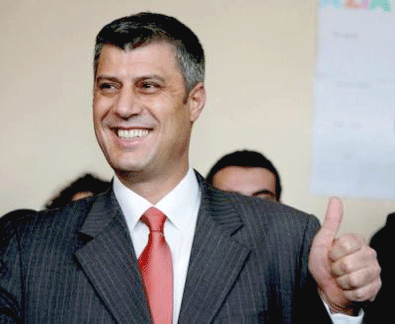
A report by Council of Europe rapporteur Dick Marty, a former Swiss prosecutor, implicated Kosovar Prime Minister Hashim Thaçi in organ trafficking (see Background). The report was released just days after the first general election held in Kosovo since the country declared independence in 2008.
The website of the Swiss daily 24 heures on Sunday quoted Mary saying that Thaçi has been prohibited from entering Switzerland "for a certain period of time".
Christa Markwalder, a Swiss Liberal politician and president of the Parliament’s foreign affairs committee, called for investigating allegations that sums originating from organ trafficking in Kosovo and Albania had been deposited in Swiss bank accounts.
In the presence of Foreign Minister Micheline Calmy-Rey, the Swiss parliament’s Foreign affairs committee is expected to debate the accusations against Hashim Thaçi on 11 and 12 January.

Background
A Council of Europe draft report alleging that Kosovo Prime Minister Hashim Thaçi is a Mafia-style boss spelled out a truth that diplomats privately acknowledge: the West in Kosovo has favoured stability over justice.
The author of the
draft report is Dick Marty, a Swiss Liberal Democrat, who gained notoriety as Council of Europe rapporteur on US rendition flights and secret prisons, including in Europe.
Marty's report said Thaçi served as a mafia-like crime boss during the war, leading a group that committed assassinations, beatings, trafficking in organs and drugs and other crimes. Reportedly, the organ-trafficking ring operated also in Albania, when forced removal of organs was taking place.

read more: euractiv

PM resignation to boost Montenegro's EU bid


euractiv

Published: 21 December 2010

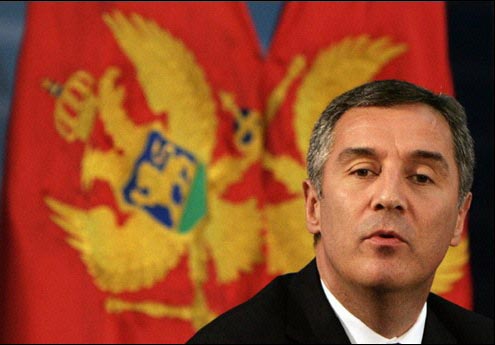
Montenegro’s Prime Minister Milo Djukanović, a controversial figure suspected of ties with organised crime, is set to resign today (21 December), in a move expected to help his country’s EU integration.


AP quoted local media saying that Djukanovic, who led the tiny Adriatic nation to independence from Serbia in 2006, is likely to be replaced by current Finance Minister and deputy Prime Minister Igor Luksic.
No reason has been given for his resignation. Djukanovic previously resigned in late 2006, but returned as prime minister in February 2008.
Djukanovic was 29 years old when he became the youngest prime minister in Europe in 1991. He was elected Montenegro president in 1998, before again assuming the premier's job in 2002 and 2008. He is the longest serving Balkan leader.
Djukanović’s departure is largely expected to improve the climate between Brussels and Podgorica. Montenegro officially received the status of EU candidate country at the EU summit which ended last Friday.
The Montenegrin government was recently accused of involvement in a tobacco smuggling operation. A court cleared Miroslav Ivanišević – a former official working for Prime Minister Milo Djukanović – of the smuggling charges, ruling that he had acted within Montenegrin law. Djukanović was also indicted, but benefited from his immunity.
In May, British newspaper The Independent named Djukanović as the twentieth richest world leader, with an estimated fortune of £10m (€12m). It described the Montenegrin leader as ''mysteriously wealthy'', referring to the smuggling allegations denied by Djukanović.
Montenegro is considered a prime location for money laundering. According to Conservative MEP Charles Tannock, rapporteur on Montenegro in the European Parliament's foreign affairs committee, it is ''a very easy place for organised crime to go, buy large amounts of unregistered euro notes through the banking system and launder them for their notes coming from another jurisdiction''.
Montenegro has never had its own currency in modern times. After using the German Deutschmark for six years, it unilaterally adopted the euro in 2002 when Germany made the switch along with the other EU members of the euro zone.

Background
Following the disintegration of Yugoslavia in 1992, Montenegro remained in a federation with Serbia. During the ensuing wars in Bosnia and Croatia, Montenegrin police and military forces participated in attacks by Serbian troops, yet Montenegro itself was untouched by the conflicts.
In 1996, Montenegro split from the regime of Serbian leader Slobodan Milošević and forged its own economic policy, unilaterally adopting the German Deutschmark as its currency. When Germany switched to the euro in 2002, Montenegro did the same – despite not belonging to the euro zone.
Serbia and Montenegro formed a new 'state union' in 2003, but three years later Montenegro held a referendum on independence: in a poll strictly monitored by the EU, 55.5% of citizens voted for separation and 44.5% voted to remain with Serbia. On 3 June 2006, Montenegro's declaration of independence was adopted by its parliament.
Montenegro, a tourist country, has an attractive Adriatic coastline and is bordered by Croatia to the west, Bosnia and Herzegovina and Serbia to the north, Kosovo to the east and Albania to the south. It has a population of just under 700,000 – one-fifth of whom live in the capital city, Podgorica.
As in all the former Yugoslav republics in the Balkans, corruption and organised crime remain a serious problem in Montenegro and legal mechanisms need to be improved, concluded the European Commission in its
latest report.

read more: euractiv

NATO-Serbia relations: New strategies or more of the same?


euractiv

Published: 10 December 2010

The Serbian government will soon have to clarify to its citizens its policy of neutrality towards NATO, argues Jelena Radoman, a research fellow at the Belgrade Centre for Security Policy.

The following contribution is authored by Jelena Radoman, research fellow at the Belgrade Centre for Security Policy and research associate at the Athens Working Group: Transforming the Balkans, a programme of the Hellenic Centre for European Studies.

"Serbia remains the Western Balkan country least interested in joining NATO despite recent improvement in relations with the Alliance and a booming arms industry.
Unlike its regional neighbours, Serbia never declared an interest in membership despite, participating in the 'Partnership for Peace' (PfP) programme since 2006 and opening its mission to NATO in 2010. The legacy of the NATO-Serb trifecta – NATO's intervention against Bosnian Serbs in 1995, the bombing campaign in 1999 and NATO members' support for Kosovo's independence since 2008 – keeps public approval for joining the Alliance low. Yet just as NATO has had to redefine its Strategic Concept, Serbia's leaders will soon have to clarify the country's declared neutrality vis-à-vis NATO.
The Serbian political leadership lacks a clear message as to whether Serbia should strive for NATO membership at all or if it has chosen alternative security projects. Without variation, several opinion polls have shown that more than 50% of the Serbian public would say 'no' to membership in NATO.
There is high support for PfP participation, which is a sign that the Serbian public is generally not well informed about what NATO or the PfP is, what membership implies and what would be the cost (political, security, economic) of the voluntarily choice to exclude oneself from that security community.
The prevailing negative image of NATO among the Serbian public has frequently served as a perfect excuse for the state leadership to artificially remove the issue of possibly joining NATO from the agenda. Since the political establishment chose not to speak clearly on the issue it is little wonder that public opinion remains in a permanently frozen ratio of less then 30% being in favour of NATO membership.
As a result, no-one in the Serbian political establishment is willing to risk their political future on NATO membership. Nor do Serbian citizens feel that NATO has much to offer them. In the past, Serbia's officials were straightforward [in stating] that future relations with NATO and the possibility of Serbia's membership could be dependent on the future status of Kosovo.
In that context, NATO's role in establishing the Kosovo Security Forces (KSF) have strained these relations. This direct connection between the Kosovo problem and Serbia's relations with NATO may be less straightforward than it used to be, since recent events indicate a thaw in relations.
The opening of the Serbian mission at NATO headquarters in Brussels this September came after two years of deadlock during which Serbian leaders constantly declared the opening of the mission as the priority in relations with NATO. Serbia is also sending a military representative to its mission at NATO, which could be seen as a sign of progress.
NATO's Military Liaison Office was established in December 2006 in Belgrade along with the Defence Reform Group (DRG) consisting of both Serbian MoD and NATO officials. The DRG was suspended after Kosovo declared independence in February 2008 and re-established in 2010.
Serbia's military industry is perhaps the biggest stakeholder in improved NATO-Serb relations. The Serbian MoD [Ministry of Defence] postures itself as the heir apparent of Yugoslavia's developed and reputable military industry.
According to the MoD, Serbia is the largest arms exporter in South Eastern Europe, selling its products 'from Malaysia to Canada and the USA'. In 2008, the arms industry earned a profit of $400 million, its highest margin since 1991. Especially prominent have been the trade contracts signed with Iraq in 2008 - worth $235 million, mostly regarding the export of infantry weapons and uniforms - and a similar contract signed with Libya in 2010, which offered the Serbian military industry an opportunity to construct a military hospital in Libya.
The MoD's top establishment argues that NATO membership would allow Serbia to develop this industry further. That argument has so far been one of the strongest in favour of NATO membership since it stresses the possible benefits Serbians could enjoy if they opt for membership.
Some political actors do try to push the issue of possible NATO membership on the daily politics agenda. Among them there are two political parties in favour of membership, one participating in the government, the Serbian Renewal Movement (SPO), and the other in opposition, the Liberal–Democratic Party (LDS), both without significant support among voters. A number of civil society organisations follow either a clear pro-NATO membership agenda or a more value-neutral approach in an attempt to improve awareness of NATO-related issues.
Arguments used by both types of actors are almost the same. The first and foremost argument is political; Serbia should not strive for the exceptional position in an environment where all other regional states have joined NATO or will soon. Likewise, NATO and EU membership go hand-in-hand, which has been the experience of all the ex-communist Central and East European states.
Second is the security argument: Serbia should not pass up the collective defence offered by NATO and military neutrality is too expensive in economic terms.
On the other side, there is a broad spectrum of actors who are explicitly against NATO. Among them are opposition parliamentary parties, which have different ideological backgrounds and origins. A number of civil society organisations are self-labelled as 'anti-NATO.'
Interestingly, the Serbian far right and far left have agreed on opposition to NATO for different reasons. For example, rightist parties and organisations label NATO an enemy who attacked Serbia in 1999 and committed war crimes for which its policymakers have never been prosecuted.
More moderate, less emotional, anti-NATO arguments make three main points: scepticism about NATO's purpose and intentions, the possible use and loss of 'Serbian boys' and a desire to consider Russian interests.
Both opponents and proponents of Serbia's NATO accession are locked into arguments with little sign of change. Public opinion may shift from Serb participation in UN or EU peacekeeping missions, and regional security initiatives.
The MoD has already declared its willingness to cooperate within the EU security umbrella, a possible substitute to the issue of NATO membership since it is both more acceptable for the Serbian public and in line with the country's EU membership ambition.
President Tadic's recent statement that it is not possible to envisage Serbia aspiring to join NATO in the foreseeable future confirms that Serbia's political leadership will take no steps to persuade the public of NATO membership's desirability. They do not necessarily have to do so if they clearly outline the country's vision of security, aside from not allowing Kosovo to secede."

read more: euractiv

Balkan gas interconnectors progress as Borissov grows wary of Nabucco


euractiv

Published: 10 December 2010 Updated: 13 December 2010

Progress on South-East Europe's gas interconnectors – small pipelines that will link the region to its more developed neighbours – is a promising sign that these countries will become less dependent on Russian imports, writes Dr. Theodoros Tsakiris, energy expert at the Hellenic Centre for European Studies (EKEM) and research associate for 'The Athens Working Group: Transforming the Balkans'.
This commentary was sent exclusively to EurActiv by the Hellenic Centre for European Studies (EKEM).
''Progress on South-East Europe's gas interconnectors, small pipelines that will link the region with the infrastructure of its developed neighbours, is a promising sign that these countries will become less dependent on Russian imports.
These developments should come to fruition in a much shorter time than what has been promised to them by the three large gas pipeline projects (ITGI, Trans-Adriatic and Nabucco), which are vying for control of Azerbaijan's Shah Deniz II field.
Bulgarian Energy Minister Traicho Traikov told an international energy conference held in Sofia on 30 November that Greece's DEPA, Italy's Edison and Bulgaria's B.E.H. have finally signed a comprehensive agreement regarding the realisation of the 3-4.5 bcm/year capacity IGB project (Interconnector Greece Bulgaria). DEPA and Edison will control, in the form of the IGI Poseidon JVC, 50% of the IGB line. BEH will own the remaining 50%.
'This is an important step forward toward the actual diversification of gas supplies for Bulgaria,' Traikov said. 'We expect that the first amounts of gas will flow in the interconnection pipe [by] early 2013.'
IGB will link over a distance of 170km the Greek city of Komotini with Bulgaria's Natural Gas Transmission System (NGTS) and is expected to cost around EUR 160 million, of which EUR 45 million have been earmarked as grant assistance by the European Energy Programme for Recovery.
The Comprehensive Agreement between IGI Poseidon and BEH includes the Project's Development Agreement, the Shareholders Agreement, while the two sides agreed to speed up the necessary processes for the establishment of a commercial subsidiary of the JVC that will control the pipeline's (Third Party Access) TPA-exempted capacity. BEH and DEPA are expected to control 35% of the commercial JVC while Edison will control 30%.
There has been no decision on the percentage of gas volume that IGB shareholders will ask to be exempted from the EU's Third Party Access regulation, but it is likely to be something in the order of 50-70% of its final throughput capacity.
Greek Deputy Energy Minister Yannis Maniatis, who met with Traikov after the signing ceremony, noted that the IGB 'will contribute to the emergence of our country into a regional gas hub that will diversify the region's natural gas sources and routes. This will on the one hand increase the strategic importance of the wider ITGI project and Greece's geostrategic role and contribution to the security of energy supply in the greater region of South East Europe'.
Traikov also said that Bulgaria was now ready to sign a Road Map - equivalent to the one it signed with Greece on IGB (July 2010) and with Russia on South Stream (November 2010) - which will spearhead the construction of the IBR (Interconnector Bulgaria Romania) project.
The IBR will extend for less than 24km and will connect the two national gas systems by crossing the Danube River from Russe in Bulgaria to Giurgiu in Romania. It is estimated to cost around EUR 30 million, of which EUR 8.9 million have been earmarked by the European Energy Programme for Recovery.
Traikov said that Bulgartransgaz, Bulgaria's state-owned Transmission System Operator (TSO), will invest another EUR 11 million in order to complete the project by 2011. Its initial capacity is estimated at 1.5 bcm/y, even though it is expected to increase to 3bcm/y, and eventually 4.5 bcm/y, so as to reach the same throughput capacity level with its two 'neighbouring' interconnectors, IGB and IRH.
One should also include Serbia, which could also get non-Russian gas through the prospective Interconnector Bulgaria-Serbia that is estimated to become operational by 2014 and is also financially supported by the European Commission.
IRH (Interconnector Romania-Hungary) was commissioned on 14 October 2010 and, despite the fact that it is operating in one direction, from Hungary to Romania, it is expected to be equipped for bi-directional use when the Romanian side takes the necessary technical measures. It has a maximum transit capacity of 4.5 bcm/y. It was jointly built by Hungarian [state oil and gas company] MOL's gas transmission unit FGSZ and Romanian system operator Transgaz.
It extends for 109 kilometres (km) – 62km on Romanian and 47km on Hungarian territory – and has been 50% financed with a EUR 68 million grant from the European Energy Programme for Recovery.
On 29 November, Hungary's state oil and gas company, MOL, signed a long-term 'soft-loan' agreement with the European Investment Bank that would help MOL foot most of the bill for the construction of another bi-flow interconnector pipeline between Hungary and Croatia that will link the two NGTS (National Gas Transmission Systems) over a distance of 294 km (88 km in Croatia and 206 km in Hungary).
The EUR 150 million EIB [European Investment Bank] loan will be used to finance the construction of the Hungarian part of the pipeline from the central Hungarian town of Varosfold to the Hungarian-Croatian border. ICH is expected to have an initial transportation capacity of 6.5 bcm/y so as to also accommodate the increased volumes of the future Adria LNG (10-15 bcm/y capacity) terminal that is currently being constructed on the island of Krk.
Adria LNG is controlled by some of the largest EU gas companies, like Austria's OMV, Germany's E.ON and France's Total, while Croatia's Natural Gas Transmission Company Plinarco owns just 1% of the Krk/Adria LNG consortium, which is expected to become operational 'not before 2017', according to the company's website.
In the meantime it is quite unclear where Hungary or Croatia would find enough gas to commercially operate the line before Adria LNG becomes operational. The ICH will most likely be used as an emergency crisis-management interconnector in case supplies from Russia are severed once more, as happened during the January 2009 gas crisis.
This is not necessarily the case with the Eastern Balkan interconnectors, thanks to the 3.6 bcm/y capacity Greek-Turkish gas pipeline or ITG, which has been operating since November 2007 and is currently covering around 20% of Greek final demand.
Through the ITG/IGB system Bulgaria expects to secure relatively prompt access to supplies of gas from Azerbaijan via the ITG pipeline. Bulgaria signed a memorandum of understanding (MOU) in late 2008 with Azerbaijan's Socar for the import of one bcm/y of gas, which has yet to materialise.
As a result, most regional states are aggressively attempting to secure Arab LNG supplies from North Africa and Qatar. During the first half of 2009 Bulgaria signed separate MOUs with Egypt and Qatar for gas that could be supplied via the Greek LNG terminal in Revythousa.
Greece had also discussed the prospect of massive Qatari LNG imports to a new LNG terminal that would be constructed in the southwestern part of Greece, near the port city of Astakos, but the project was sunk on 20 October 2010, when the consortium decided to 'abandon ship' due to the lack of commercial interest from Italy, which would have accounted for more than 70% of the terminal's LNG exports.
Bulgaria's Prime Minister Boyko Borissov, has claimed that his government will be unable to fulfil its financial obligations of EUR 2 bn vis-à-vis its Nabucco partners, if the European Commission does not grant Sofia an exemption in book-keeping rules that would somehow exclude Nabucco from Bulgaria's national budget, and in particular from its inclusion in the calculation of the budget deficit.
'I will not halt the project, but we all must understand it would lead us to an over deficit,' Borissov noted. Borissov's position should not come as a surprise. Regional states do not have to gain as much as north and central European gas consumers from the construction of the three competing natural gas mega projects, namely Nabucco, ITGI and Trans-Adriatic.
These projects, of which only one can be built by 2016, depending on who wins the ongoing Shah Deniz II tender, are too costly to bear for the crisis-hit economies of Southeast Europe. IMF-sustained Bulgaria and Romania would have to pay around $1.3 billion each for their share of Nabucco in order to get approximately the same volumes of gas they could get from the intra-regional interconnectors.
On the other hand, these aforementioned interconnectors can become commercially operational with Arab LNG imports as early as 2013 and constitute the cheapest, fastest and most geopolitically risk-free means of limiting the region's dependence on Russian gas imports, which still satisfies more than two-thirds of Greek demand, and almost all demand in Bulgaria, Serbia and the former Yugoslav Republic of Macedonia.
So energy diversification is within the region's reach if it can follow through on the gas interconnectors built, above all else, on the principle of a 'win-win' mentality.''

read more: euractiv
EU’s Kosovo force may probe ‘organ trafficking’ (video)


euronews

Mafia

16/12 01:13 CET

Kosovo’s EU-backed police force said on Wednesday it will investigate suspected links between the country’s prime minister and an alleged organ trafficking ring.
But investigators say they need more evidence before they can probe accusations made in a Council of Europe report that PM Hashim Thaci ran a mafia-style crime organisation.
“We encourage everyone to come forward with those evidences to the appropriate authorities,” said EULEX spokeswoman Karin Limdal.
The report, authored by Swiss senator Dick Marty, says the Kosovo Liberation Army shot dead civilian detainees during its war for independence from Serbia then sold their organs on the black market.
The Kosovo government swiftly rejected the report, which also accused Thaci of heading a group within the ethnic-Albanian guerrilla Kosovo Liberation Army (KLA) that set up a network of unofficial prisons in Albania.
Hashim Thaci previously served as the KLA’s political leader during the 1998-1999 conflict.
He became prime minister of Kosovo after its split from Serbia in 2008.

read more: reuters

Thaci: claims of skeletons in the closet (video)


euronews

Mafia

16/12 19:01 CET

Hashim Thaçi had barely 24 hours to savour his PDK party’s victory in the first parliamentary elections since Kosovo’s self-declared independence.
The next day came the Council of Europe report, accusing the prime minister of once being a Mafia-style boss.
His government denounced as baseless the claims against the man dubbed “The Snake” for his ability to slip out of the grasp of Serb police.
The allegations date back to just after the 1999 war, when NATO took control of the territory still claimed by Serbia.
Originally from the Dranica region, after some years studying in Switzerland, Hashim Thaçi became one of the commanders of the KLA, the Kosovo Liberation Army, which emerged in 1997.
He was present amid the negotiations with Serbia, at Rambouillet in France in early 1999. Rejected by Belgrade, the resulting plan led to NATO’s intervention in Kosovo and bombardments against Serbia.
According to the report, during the war Thaçi acted like the head of an organised crime network that carried out assassinations, beat people up and trafficked organs and drugs. At the end of the war Thaçi formed the Democratic Party of Kosovo, the PDK, members came mainly from the KLA.
The first person to publicly accuse Thaçi of involvement in organ trafficking was Carla del Ponte. In 2008 the former chief prosecutor in the UN tribunal for the former Yugoslavia published a book called “The Hunt”, claiming that after the war the KLA kidnapped 300 Serbs from Kosovo and transported them to a village in Albania.
In a house in Gurre it is alleged that organs were removed from the prisoners, who were then killed. The organs were then sent abroad for the black market, via the airport at Rinas.
Back in 2008, Human Rights Watch sent a letter to the prime minister asking him to open an inquiry, in view of the gravity of del Ponte’s claims.
The justice minister rejected the allegations then, describing them as “fabrications”. The Pristina government is adopting a similar stance today, threatening legal action over what it calls slanderous claims.
As for the EU’s law enforcement mission, EULEX, it says it has limited resources to investigate.

read more: euronews

Kosovo PM rejects “mafia-style” crime claims (video)


euronews

16/12 19:24 CET

Inquiry

The prime minister of Kosovo has strongly refuted sensational claims that he led an organised crime ring that killed opponents and trafficked in organs.
Hashim Thaci is outraged at a report presented to the Council of Europe in Paris today. The rights group’s investigator Dick Marty, however, stands by the allegations of atrocities, saying major powers were aware but chose not to act.
“This was known by many people who would tell you in private: ‘Yes, we know, but for political reasons we have decided, or we have a duty, to remain silent,’” Marty said.
But in Pristina, responding for the first time since the report was made public, Kosovo’s Prime Minister slammed it as “scandalous.” He denounced what he said was a campaign aimed at damaging Kosovo’s image and said he would use all political and legal means to bring the truth to light.
Having earned some international respectability after his time as an ethnic-Albanian rebel leader, Thaci’s own political future may now be on the line. However even opposition politicians at home have rallied to his defence. But analysts say the report may, indeed, damage Kosovo’s image, in countries that backed its independence drive.

read more: euonews